Herbal pharmacy
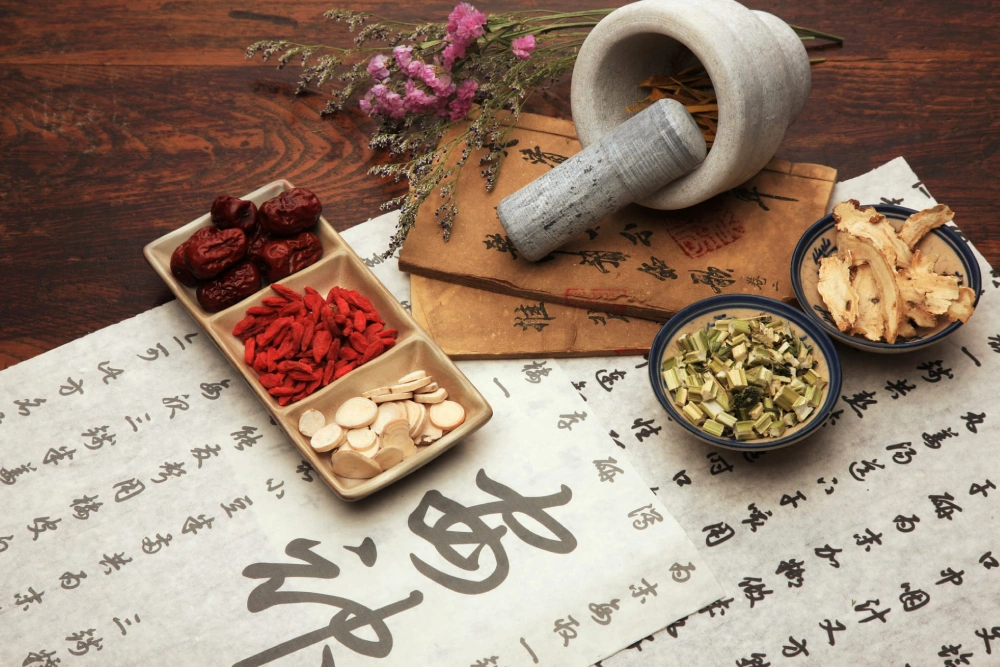
In Chinese medicine, herbs are a preventive agent or a separate therapeutic or complementary treatment for acupuncture. In China, they are even used on a daily basis in nutrition, adding them to dishes or tea. In replacement or complementary therapy for acupuncture, special, the so-called “Herbal Formulas”, usually consisting of a few to a dozen ingredients, mutually complementary or synergizing. Such formulas have a history of being developed by historical doctors in their laboratories. A multitude of herbal formulas have been proven to be effective for many centuries. They are successfully used for various ailments, diseases, pandemics.
Chinese herbal medicine, used for 4,000 years in the East, provides basic health care to almost a quarter of the world’s population.
The earliest records of herbs in China date back to the Zhou Dynasty and earlier, when the oldest mention of the healing effects of herbs was found in the Classics of Change (Yi Jing) and the Classic of Poetry (Shi Jing) (Reid, 1996). In these classics, dozens of herbs are listed in different contexts related to treatment and diet.
In the 21st century, interest in alternative treatment, particularly herbal medicine, is growing rapidly around the world. This is because Chinese medicine provides more comprehensive solutions and extremely satisfying results. In addition, Chinese medicine emphasizes the prevention of diseases, as well as their treatment.
The traditional Chinese medicine (TCM) system of healing states that the disease is the result of a person’s underlying organ function defects or a person’s yin and yang imbalance. When a disease develops, no matter what it is or where exactly it is located, the whole body gets sick. Therefore, treatment should be directed at the cause of the disease and the whole person. On the other hand, Western medicine considers the disease to be an isolated entity in the body and its treatment is usually aimed only at symptoms.
The TCM approach perceives each patient and ailment in a unique and distinct way. The causes of the same disease can be completely different, even if two people suffer from the same ailments. Therefore, they can be treated completely differently. This approach is more effective than the conventional Western approach, which involves using the same drug therapy for all people with similar symptoms. Both in its philosophy and practical application towards treatment, TCM has a lot to offer Western medicine.
Although there are different branches of TCM, such as Chinese herbal medicine, acupuncture and Qigong, the fundamental philosophy is the same. Westerners may be most familiar with the metaphysics of Yin and Yang, representing the two ends of the spectrum, such as cold-hot, woman-man, or interior-outside. When this concept is applied to the human body, Yin and Yang are associated with different parts or organs of the body, or simply with the feeling of cold and heat. According to the philosophy of Taoism, man should maintain the Yin and Yang balance; otherwise, or if this balance is violated, it will cause various syndromes or diseases. Then, for example, herbs with “hot” properties can be used to treat “cold” syndrome and vice versa.
Another basic theory in TCM is the Five Elements theory, which describes the human body and herbs using five elementary traits (Wood, Fire, Earth, Metal, and Water). For example, water represents the kidneys, bladder, fire represents the heart, small intestine and tongue. Since the five elements are related both in the circle of creation (Wood → Fire → Earth → Metal → Water → Wood) and in the circle of destruction (Wood → Earth → Water → Fire → Metal → Wood), all organs in the body are also connected and can be influenced according to the attributes of the respective herbs.
Literature:
Beijing TCM College (1980). “Essentials of Chinese Acupuncture”. Beijing:
Joseph P. Hou. “The Healing Power of Chinese Herbs and Medicinal Recipes”
Scientific publication: Chan K. (1995). “Progress in traditional chinese medicine”. Trends Pharmacol Sci. 16, 182–187. 10.1016/S0165-6147(00)89019-7.